What Causes Bad Breath Even After Brushing?
You brush your teeth properly. Maybe even twice a day. You’ve tried mouthwash, mints, and chewing gum. Yet somehow, that lingering bad breath just doesn’t go away.
If this sounds familiar, you’re not alone—and more importantly, you’re not doing something “wrong.”
Persistent bad breath (also called halitosis) is rarely just about brushing. In fact, in most cases, the real cause lies beyond what your toothbrush can reach—like bacteria on your tongue, hidden gum infections, dry mouth, or even underlying health conditions.
What makes it frustrating is this:
You feel like you’re doing everything right, but the problem still shows up in conversations, meetings, or close interactions—affecting your confidence without you fully understanding why.
The good news?
Bad breath that continues even after brushing is usually treatable once you identify the exact cause.
In this guide, you’ll understand:
- Why brushing alone often isn’t enough
- The real reasons your breath still smells
- And how to finally fix it—based on the root cause, not guesswork
Let’s start by quickly understanding what’s actually happening inside your mouth.
Why Your Breath Still Smells Even After Brushing
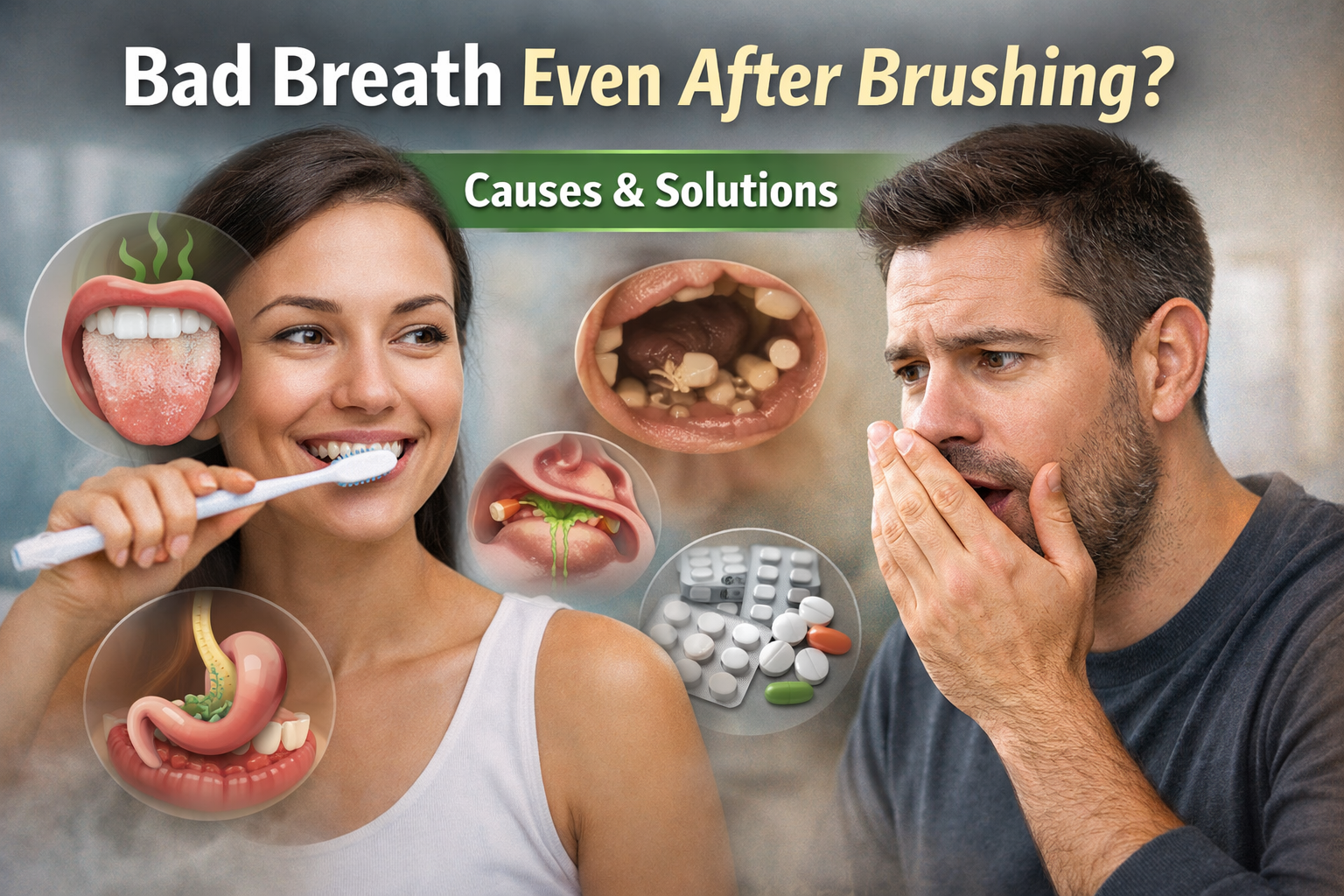
In simple terms, bad breath that continues even after brushing happens because brushing only cleans the surface of your teeth—not the deeper sources where odor actually forms. In most cases, the smell comes from bacteria breaking down food particles and releasing foul-smelling gases, often from areas your toothbrush doesn’t fully reach.
Dentally speaking, this condition is known as halitosis, and studies show that around 80–90% of persistent bad breath starts inside the mouth itself—mainly from the tongue, gums, and spaces between teeth. The remaining cases are linked to sinus issues, digestive problems, or certain medical conditions.
Here are the most common reasons your breath may still smell even after brushing:
- Tongue coating: A layer of bacteria and debris on the tongue that produces odor
- Gum disease: Infections below the gumline where bacteria thrive unnoticed
- Cavities or tooth decay: Trapped food and bacteria inside damaged teeth
- Dry mouth: Reduced saliva, which normally helps clean your mouth naturally
- Sinus or postnasal drip: Mucus buildup that affects breath smell
- Acid reflux (GERD): Stomach contents affecting breath odor
- Medical conditions like diabetes: Which can change the smell of your breath
There’s also one more overlooked factor—how you brush. Even if you brush regularly, missing key areas like the tongue, gumline, or back teeth can allow odor-causing bacteria to stay active.
So if your breath still smells despite brushing, it’s not just a hygiene issue—it’s a root cause issue. And once you identify that cause, fixing it becomes much more straightforward.
You’re Not Alone – How Persistent Bad Breath Affects Daily Life
If you’ve ever felt unsure about your breath while talking to someone, you already know this isn’t just a “dental issue”—it’s something that quietly affects your confidence.
Most people in your situation are doing everything they can. They brush more often, use mouthwash, chew gum before meetings, or try to keep a distance while speaking. And yet, there’s still that constant doubt in the back of the mind—“What if my breath still smells?”
This is where the real impact begins.
It starts affecting everyday interactions
You may find yourself:
- Hesitating before speaking in close conversations
- Turning your face slightly while talking
- Avoiding long conversations, dates, or meetings
It’s subtle, but over time, it changes how you show up socially and professionally.
There’s also confusion and silent worry
What makes it more frustrating is that you’re already maintaining hygiene. So naturally, questions come up:
- “Am I missing something?”
- “Is this coming from my stomach?”
- “Could this be something serious?”
That uncertainty often creates more stress than the problem itself.
Here’s the truth most people don’t hear
Persistent bad breath is actually very common—and in most cases, it has a clear, identifiable cause. It’s not about poor hygiene or something to feel embarrassed about. It’s usually a sign that something specific (like tongue bacteria, gum issues, or dryness) is being overlooked.
And once you understand what’s really causing it, the problem becomes much easier to fix.
So if you’ve been dealing with this quietly, thinking you’re the only one—you’re not. And more importantly, you’re much closer to solving it than you think.
Tongue bacteria and the tongue microbiome
Your tongue isn’t just a flat surface—it has tiny grooves and textures where bacteria easily settle. Over time, this creates a layer called tongue coating, made up of food debris, dead cells, and microbes.
What’s important to understand is that these bacteria form a kind of ecosystem, often referred to as the tongue microbiome. When harmful bacteria dominate, they break down proteins and release strong-smelling gases.
This is why even after brushing your teeth, your breath can still smell—because the main source is sitting on your tongue, not your teeth.
Dry mouth and lack of saliva (Xerostomia)
Saliva plays a much bigger role than most people realize. It’s not just there to keep your mouth moist—it acts like a natural cleaning system, constantly washing away bacteria and food particles.
When saliva production drops, bacteria multiply more easily, leading to persistent odor.
This can happen due to:
- Dehydration
- Mouth breathing (especially during sleep)
- Certain medications
- Underlying health conditions
If you notice worse breath in the morning or a dry, sticky feeling in your mouth, dryness could be a major factor.
Tonsil stones and throat-related issues
Sometimes the source isn’t in your teeth or gums at all.
Tonsil stones are small, hardened deposits that form in the crevices of your tonsils. They’re made of trapped debris, bacteria, and mucus—and they can produce a very strong, unpleasant smell.
People often don’t realize they have them because they’re hidden, but they can be a persistent cause of bad breath that brushing won’t affect.
Gut and reflux-related causes (GERD and digestive issues)
If you experience acidity, heartburn, or a sour taste in your mouth, your breath issue might be linked to acid reflux (GERD).
In this condition, stomach contents and gases move upward into the esophagus, which can influence breath odor. Even if your mouth is clean, the smell can originate from deeper in the digestive system.
Sinus, nose, and respiratory issues
Chronic sinus infections or postnasal drip can also play a role. When mucus builds up and drips down the back of your throat, it creates an environment where bacteria thrive.
This can lead to a foul smell that feels like it’s coming from your mouth, even though the source is actually your nasal passages or throat.
The key takeaway here is simple:
If your breath still smells despite good brushing, it’s often because the real cause is hidden in areas you’re not addressing directly.
Once you identify which of these factors applies to you, the solution becomes much more targeted—and much more effective.
Medical Causes You Shouldn’t Ignore
One of the most common medical causes of chronic bad breath is gum disease. It starts as mild inflammation (gingivitis) but can progress into periodontitis, where bacteria go deeper below the gumline. Safely treating this requires specialized Periodontics & Gum Treatments to eliminate the deep-seated bacteria that standard brushing cannot reach.
In many cases, your breath is actually giving you an early signal that something needs attention.
Cavities, broken fillings, and dental infections
Tooth decay creates small holes where food particles and bacteria get trapped. Over time, this leads to a constant source of odor that can be easily repaired using durable Tooth Coloured Fillings . Similarly, old or damaged fillings can create hidden gaps where bacteria build up unnoticed, often requiring structural reinforcement like dental Crowns / Bridges. In more advanced cases where an infection reaches the tooth’s nerve, a precise Laser Microscope Assisted RCT
may be necessary to save the tooth and eliminate the odor at its root.
Diabetes and other systemic conditions
Certain medical conditions can also affect how your breath smells. For example, uncontrolled diabetes may cause a distinct change in breath odor and is often linked with dry mouth, which further worsens the problem.
Bad breath in such cases isn’t just a surface issue—it can reflect how well the condition is being managed internally.
Liver, kidney, and other serious conditions
In rare cases, persistent and unusual breath odor can be linked to conditions affecting the liver or kidneys. These organs help filter toxins from the body, and when they’re not functioning properly, it can sometimes show up as changes in breath smell.
This isn’t common, but it’s important to be aware—especially if bad breath is accompanied by other unexplained symptoms like fatigue, weight loss, or general discomfort.
The key thing to understand is this:
If your bad breath is persistent and doesn’t improve with proper oral care, it’s not something to keep guessing about.
It’s a signal.
And the sooner you identify the exact cause—whether dental or medical—the easier it becomes to treat it properly and avoid bigger issues later.
Common Brushing Mistakes That Keep Bad Breath Going
Sometimes, the issue isn’t that you’re not brushing—it’s how you’re brushing.
A lot of people follow a routine consistently but still leave behind the very areas where odor-causing bacteria thrive. Over time, these small gaps in technique can keep bad breath going, no matter how often you brush.
Only focusing on the front teeth
Most people naturally pay more attention to the front teeth because they’re visible. But the back teeth, inner surfaces, and areas near the gumline are where food particles and plaque tend to accumulate the most.
If these areas aren’t cleaned properly, bacteria continue to grow and produce odor—even if your smile looks clean from the outside.
Ignoring the tongue completely
This is one of the biggest reasons bad breath doesn’t improve.
The tongue, especially the back portion, holds a layer of bacteria and debris that brushing alone doesn’t remove. If you skip cleaning your tongue, you’re leaving behind one of the main sources of odor.
Even a proper brushing routine can feel ineffective if the tongue is not addressed.
Brushing too quickly or without technique
Brushing for a few seconds or using random strokes doesn’t remove plaque effectively. The gumline, in particular, needs gentle and consistent cleaning because that’s where bacteria tend to collect.
When brushing becomes a rushed habit rather than a mindful routine, a lot gets missed without you realizing it.
Skipping flossing or cleaning between teeth
Your toothbrush cannot reach the tight spaces between teeth. These areas trap food particles, which then break down and create a bad smell over time.
If flossing or interdental cleaning isn’t part of your routine, you’re leaving behind hidden sources of odor every day.
Relying too much on mouthwash
Mouthwash can make your breath feel fresh temporarily, but it often only masks the smell rather than fixing the cause.
If there’s gum disease, tongue buildup, or decay, mouthwash alone won’t solve it. In some cases, overusing it can even dry out the mouth, which makes the problem worse.
The important shift here is simple:
Bad breath isn’t just about brushing regularly—it’s about cleaning the right areas, in the right way.
Once these small mistakes are corrected, many people notice a significant improvement. But if the problem still continues, it usually means there’s a deeper cause that needs to be identified.
How to Diagnose the Real Cause of Your Bad Breath
This is the point where most people keep guessing—and that’s exactly why the problem continues.
You try different toothpastes, mouthwashes, or home remedies, hoping something will work. But bad breath doesn’t improve consistently until you understand where it’s actually coming from.
The goal here is not to overcomplicate things, but to give you a simple way to start identifying the source.
Simple at-home checks (to get a rough idea)
While these aren’t perfect, they can give you initial clues:
- Gently scrape the back of your tongue and notice the smell
- Smell dental floss after cleaning between your back teeth
- Pay attention to whether the odor is worse in the morning or throughout the day
- Ask a trusted person for honest feedback
These small checks can help you understand whether the issue is likely coming from your mouth or somewhere else—but they’re only a starting point.
Signs your bad breath is mainly coming from the mouth
In most cases, the cause is oral. You might notice:
- A coated or white layer on your tongue
- Bleeding gums while brushing or flossing
- Food getting stuck between teeth frequently
- A constant bad taste in your mouth
- Dryness or reduced saliva
If these feel familiar, the source is likely related to tongue bacteria, gum health, or dental issues.
Signs it may be linked to sinus, stomach, or overall health
If your oral hygiene is consistent but the problem persists, look for patterns like:
- Frequent nasal congestion or postnasal drip
- Acid reflux, heartburn, or a sour taste
- A feeling that the odor is coming from deeper in the throat
- Existing medical conditions or medications causing dryness
In these cases, the root cause may not be purely dental and could require a broader evaluation.
What happens during a professional breath assessment
A dentist doesn’t just check your teeth—they look at the complete picture. To get an accurate diagnostic look beneath the surface, this assessment typically begins with a diagnostic Full Mouth X‑Ray to reveal hidden decay, bone loss, or infections. A comprehensive evaluation usually includes:
- Examining your gums for hidden infection
- Checking for cavities, plaque buildup, or faulty fillings
- Assessing tongue coating and oral hygiene patterns
- Understanding your medical history, habits, and symptoms
In some cases, they may also identify signs that point toward sinus or digestive issues and guide you accordingly.
The biggest advantage here is simple:
Instead of guessing, you get a clear diagnosis and a targeted solution.
If you’re unsure what’s actually causing your bad breath, this is the step that changes everything. A proper assessment helps you stop trying random fixes and start solving the problem at its root.
Treatment Options – From Home Remedies to Professional Care
Once you understand what’s causing your bad breath, the next step becomes much clearer—treatment should match the root cause. This is where many people go wrong. They try general solutions, but bad breath isn’t a one-size-fits-all problem.
In some cases, simple changes at home can make a big difference. In others, professional treatment is necessary to fully resolve it.
What actually works at home (when the cause is oral)
If your bad breath is mainly due to tongue coating, food buildup, or mild plaque, improving your daily routine can help significantly.
Focus on:
- Brushing thoroughly twice a day, especially along the gumline and back teeth
- Cleaning your tongue daily, ideally from back to front
- Flossing or using interdental brushes to remove trapped food between teeth
- Staying hydrated so your mouth doesn’t become dry
- Using a dentist-recommended mouthwash when needed (not as a replacement, but support)
These habits target the areas where odor usually begins. But consistency matters—doing this properly for a few days won’t fix a long-term issue unless it’s maintained.
When professional dental treatment is needed
If the cause goes deeper—like gum disease, cavities, or hidden infections—home care alone won’t be enough. Whenever possible, we focus on Minimally Invasive Dentistry to address these concerns effectively while preserving your natural tooth structure. Depending on your assessment, a dentist may recommend:
- Scaling and deep cleaning to remove tartar and bacteria below the gumline
- Treatment for gum disease, especially if there’s bleeding or inflammation
- Filling cavities or fixing damaged restorations where bacteria accumulate
- Managing infections or abscesses that contribute to persistent odor
These treatments don’t just improve breath—they address the underlying health of your mouth.
When the cause is beyond dental
If your dentist rules out oral causes, the next step may involve looking at other factors like reflux, sinus issues, or medical conditions.
In such situations, you may be guided to consult:
- An ENT specialist for sinus or tonsil-related problems
- A physician or gastroenterologist for acid reflux or digestive concerns
The important thing is coordination—because bad breath can sometimes be a multi-factor issue, not just a single cause.
Here’s the key shift to understand:
You don’t need more products—you need the right approach for your specific cause.
If home remedies haven’t worked so far, it’s usually a sign that the issue requires a deeper evaluation and targeted treatment. And once that’s done correctly, most cases of bad breath can be managed—and often completely resolved.
When Should You See a Dentist About Bad Breath?
A lot of people wait too long before seeking help. They assume bad breath is something temporary or something they just need to “manage” with better brushing or mouthwash. But when the problem keeps coming back, it’s usually a sign that something deeper needs attention.
The real question isn’t “Do I have bad breath?”—it’s “Is this something I can fix on my own, or do I need professional help?”
Signs you shouldn’t ignore
If you notice any of the following, it’s a good idea to stop guessing and get it checked:
- Bad breath that lasts for weeks even after proper brushing and flossing
- Bleeding, swollen, or sensitive gums
- A constant bad taste in your mouth
- Food getting stuck frequently or visible buildup on teeth
- Pain, discomfort, or signs of infection
- Regular acidity, reflux, or sinus issues along with bad breath
These aren’t just minor issues—they’re indicators that the cause may be beyond surface-level hygiene.
What actually happens when you visit a dentist
One reason people hesitate is uncertainty. They don’t know what to expect.
In reality, the process is straightforward and focused on clarity. A dentist will:
- Listen to your symptoms and history
- Examine your teeth, gums, and tongue carefully
- Check for hidden issues like gum pockets, decay, or buildup
- Identify whether the cause is oral or possibly linked to something else
Instead of trial and error, you get a clear explanation of what’s causing the problem and what to do next.
Why this step changes everything
Once the root cause is identified, treatment becomes simple and targeted. Many people feel immediate relief—not just physically, but mentally—because they finally understand what was wrong.
If you’ve been dealing with bad breath despite doing everything right, this isn’t something you need to keep managing on your own.
Getting it checked isn’t a big step—it’s the right step.
Build a routine that actually works
A strong foundation is simple, but it needs to be done properly:
- Brush twice a day, giving attention to the gumline and back teeth—not just the front
- Clean your tongue daily, especially the back portion where bacteria accumulate
- Floss or clean between teeth at least once a day to remove hidden food particles
- Visit a dentist regularly for professional cleaning and early detection of issues
These habits don’t just keep your teeth clean—they prevent the buildup that leads to odor in the first place.
Support your mouth’s natural cleaning system
Saliva plays a key role in keeping your breath fresh. When your mouth stays hydrated, it naturally washes away bacteria and debris.
To support this:
- Drink enough water throughout the day
- Avoid long periods of dryness, especially if you talk a lot or breathe through your mouth
- Consider simple habits like chewing sugar-free gum to stimulate saliva if needed
If dryness is persistent, it’s worth discussing with a dentist or doctor, as it can be linked to medications or underlying conditions.
Pay attention to lifestyle triggers
Some everyday habits can quietly contribute to bad breath without you realizing it.
Things like tobacco use, excessive alcohol, and frequent consumption of sugary or strong-smelling foods can create an environment where odor-causing bacteria thrive.
At the same time, if you have conditions like acidity or diabetes, managing them properly also plays a role in keeping your breath under control.
The key idea here is not perfection—it’s consistency.
When your daily habits align with how your mouth actually works, bad breath doesn’t become something you constantly fight. It becomes something you naturally prevent.
How it affects confidence and relationships
It’s not always obvious, but many people dealing with persistent bad breath experience:
- Hesitation in meetings, interviews, or public speaking
- Discomfort during close conversations or social situations
- Overthinking how others might be reacting
Even if no one says anything directly, that internal doubt can be enough to make you withdraw slightly. And when this continues, it starts affecting your overall confidence.
Breaking the cycle of embarrassment
One important thing to understand is this: bad breath is rarely a “personal failure.” It’s usually the result of a specific, treatable cause—something that hasn’t been identified yet.
But because it’s a sensitive topic, people tend to hide it or try to manage it quietly instead of addressing it properly. That’s what keeps the cycle going.
Once you shift from managing the symptom to understanding the cause, everything changes. You move from uncertainty to clarity—and with that comes relief.
The real transformation isn’t just fresh breath.
It’s being able to speak, interact, and show up without second-guessing yourself.
And that starts the moment you stop guessing and start addressing the problem at its root.
FAQs
Even after understanding the causes, a few questions still tend to come up. These are the exact doubts most people have when they’re dealing with persistent bad breath.
Why does my breath still smell after brushing and using mouthwash?
Because brushing and mouthwash mainly clean the surface, not the source. If the cause is tongue buildup, gum disease, dry mouth, or something like sinus issues or reflux, these won’t be fixed by surface cleaning alone. Mouthwash may temporarily mask the smell, but the underlying bacteria or condition continues to produce odor.
Is my bad breath coming from my mouth or my stomach?
In most cases, the source is the mouth—especially the tongue, gums, or areas between teeth. However, if you have symptoms like acidity, heartburn, or a sour taste, it could be linked to reflux. The best approach is to first rule out oral causes with a dental check, and then explore other possibilities if needed.
Can bad breath be cured permanently?
In many cases, yes—especially when the root cause is identified and treated properly. If it’s due to plaque buildup, tongue coating, or dental issues, it can be resolved and controlled with the right care. However, if it’s linked to chronic conditions like dry mouth or medical issues, it may require ongoing management rather than a one-time fix.
How long should I try home remedies before seeing a dentist?
If you’ve improved your brushing, flossing, and tongue cleaning consistently for a couple of weeks and still notice bad breath, it’s a good idea to get it checked. You shouldn’t wait if there are additional signs like bleeding gums, pain, or persistent dryness.
Which specialist should I see first for chronic bad breath?
The best starting point is a dentist. Since most cases originate in the mouth, a dental evaluation can either identify the issue or rule it out. If needed, the dentist can guide you toward an ENT specialist or physician for further investigation.
The common pattern across all these questions is simple:
Bad breath becomes confusing when you try to solve it generally. It becomes clear when you start looking at it specifically—based on its actual cause.
Take Control of Your Breath and Confidence
Bad breath even after brushing is more common than most people think—and in most cases, it has a clear, treatable cause. It’s rarely about not brushing enough. It’s about not addressing the actual source.
Once you shift your focus from surface cleaning to understanding the root cause—whether it’s tongue bacteria, gum health, dryness, or something beyond the mouth—you stop guessing and start solving the problem properly.
And that’s where everything changes.
If you’ve been dealing with this quietly, trying different solutions without real clarity, the next step is simple: get a proper evaluation.
Because fresh breath isn’t just about hygiene—it’s about confidence, comfort, and being able to interact without hesitation.
And once the cause is identified, that confidence comes back naturally.