Dental Crown vs Filling: Which One Do You Actually Need? (Bangalore Cost & Decision Guide)
If you’ve just walked out of a dental consultation and your dentist mentioned “you might need a crown” when you came in expecting a simple filling, you’re probably wondering one thing: is this actually necessary, or am I being upsold?
It’s a fair question. Crowns cost more, take longer, and involve more drilling than a filling. So here’s the good news: the decision isn’t really a judgment call. Dentists follow fairly precise structural rules to decide between the two, and once you understand them, you’ll be able to look at your own X-ray and have a real conversation about your treatment instead of just nodding along.
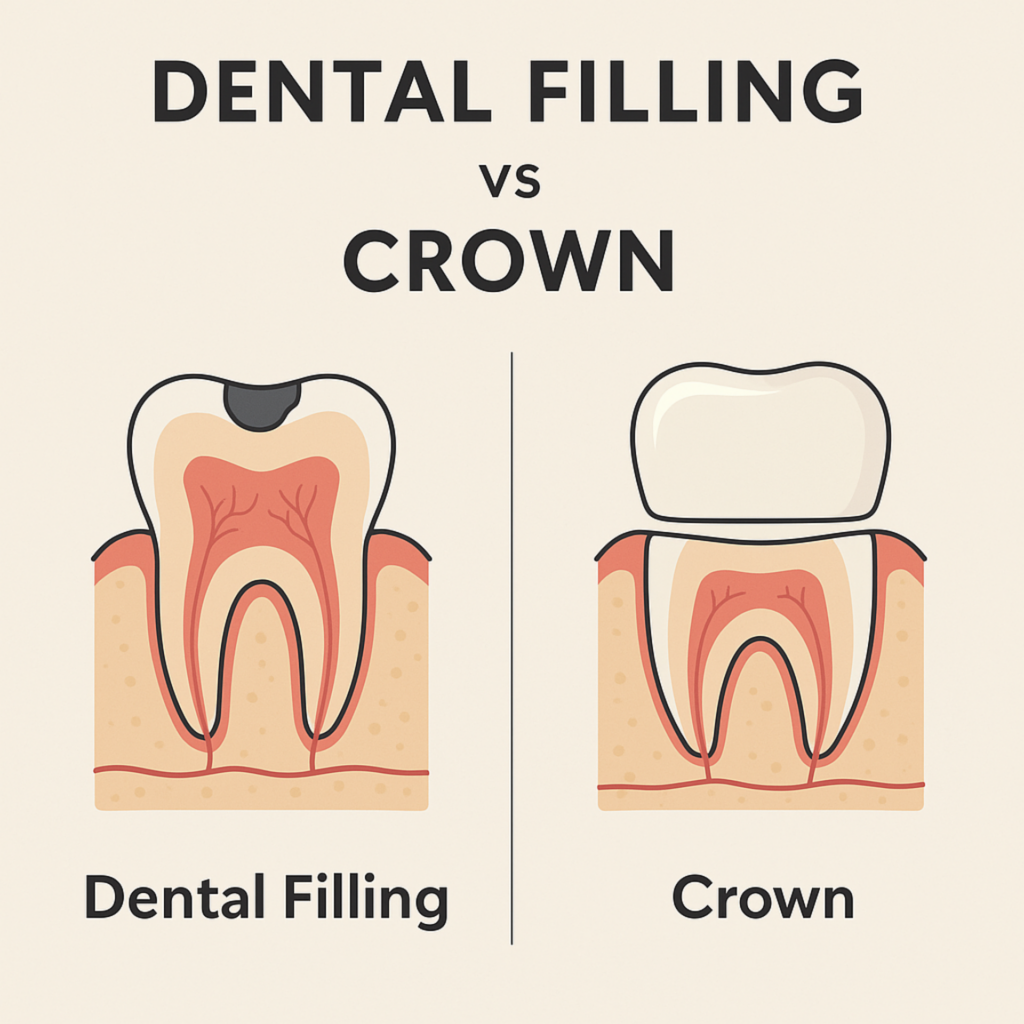
Think of your tooth like a small but very hardworking bridge. Every time you bite down, especially on your back teeth, you’re putting up to 700 newtons of force through it — that’s roughly the weight of a grown adult standing on a single point. A healthy tooth handles that easily because its walls are thick enough to spread the load. But once decay or a crack removes some of those walls, the remaining tooth doesn’t carry the load anymore — it flexes. And a filling dropped into a flexing tooth doesn’t fix that; it just sits there as a wedge, slowly increasing the chance that the tooth cracks.
That’s the entire logic behind the filling-vs-crown decision: how much “wall” is left to resist that force.
The 50-40-30 Rule: How Dentists Actually Decide
There’s a simple set of thresholds dentists use to judge this, and once you’ve heard it, you’ll never look at a filling the same way again.
A crown (or at least a partial-coverage restoration) is generally needed once damage crosses any one of these lines:
More than 50% of the width between the cusp tips (the chewing bumps) is gone
More than 40% of the tooth’s front-to-back length is gone
More than 30% of the total tooth volume is gone
There’s an even simpler version some dentists use mentally: if less than a third of the tooth is damaged, a filling is fine. If it’s between a third and a half, a crown should be seriously considered. Past half, a filling alone is genuinely risky — the tooth is structurally one stress event away from cracking.
One more detail that matters more than people realize: if any single cusp wall is thinner than 2mm, that wall needs to be covered and protected, not just filled — even if the rest of the tooth looks fine on the surface.
Why a Root Canal Changes Everything
Here’s something most patients are never told plainly: once a tooth has had a root canal, the rules change, even for a relatively small cavity.
A root-canalled tooth loses its internal blood supply and moisture. Over time, the dentine left behind becomes noticeably more brittle — like a green branch slowly turning into a dry one. It can still take a direct hit, but it has lost its ability to absorb stress gradually, which is exactly what your back teeth need when you’re chewing all day.
This is why dentists recommend crowns on root-canalled back teeth almost as a default, not as an upsell. And the data on this is striking: one large US study tracking over 71,000 root-canal-treated teeth found that a tooth restored with a buildup filling and a crown lasted a median of 20.1 years. A tooth restored with just a filling, no crown, lasted a median of 11.2 years. That’s almost double the lifespan, from one decision made right after the root canal.
What 10 Years of Real Patient Data Actually Shows
It’s easy to dismiss “you need a crown” as a sales pitch until you look at what happens to teeth over the long run when people choose otherwise.
A 2025 Swedish study tracked 343,809 teeth over 5 to 10 years, comparing large fillings to crowns. The teeth restored with crowns had a 92.77% survival rate at 10 years. The ones restored with large fillings: 89.09%. That gap might look small, but it represents a meaningfully higher rate of teeth needing retreatment, refilling, or extraction down the line.
A separate 10-year study from the University of Michigan followed 518 teeth restored either with large fillings or full crowns. The results were sharper: 64% of the large fillings eventually needed retreatment, compared to just 32% of the crowns. And when researchers looked specifically at catastrophic failures — the kind where the tooth cracks beyond saving — it happened in 22% of the filled teeth versus 12% of the crowned ones. Statistically, that’s a 2.1 times higher risk of losing the tooth entirely when a large filling is used instead of a crown.
None of this means “always choose the crown.” It means: past a certain point of damage, a filling isn’t really the conservative option anymore — it just delays a harder decision.
The Middle Ground: Do You Really Need a Full Crown?
Here’s the part most blog posts skip, and it’s the part that actually protects your tooth and your wallet: a full crown isn’t the only alternative to a filling.
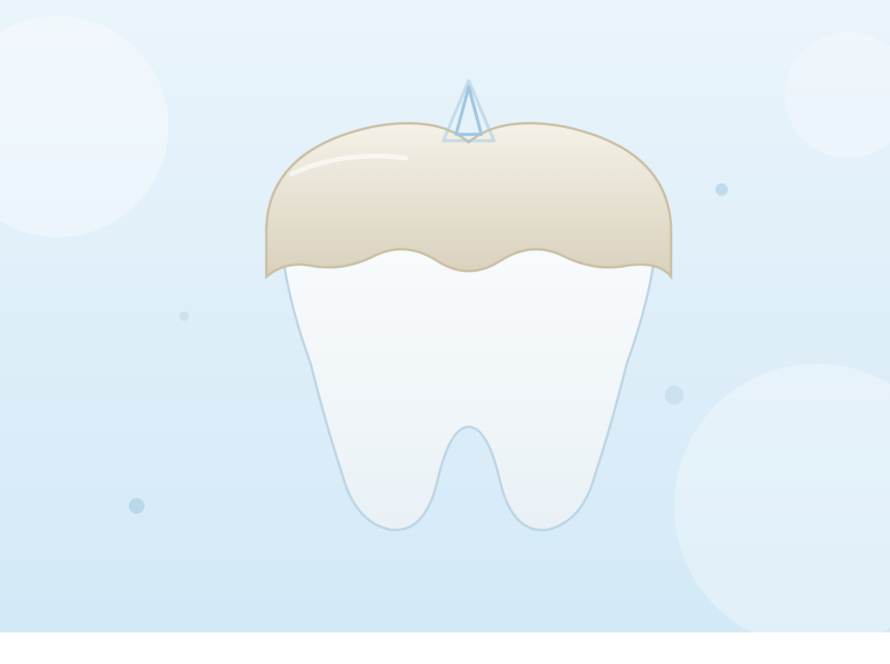
Inlays and onlays sit in between. An inlay fits neatly inside the chewing surface when the outer walls of the tooth are still strong. An onlay extends slightly further to cap one or two weakened cusps, without touching the healthy walls around them. The effect is similar to a crown — it spreads the bite force evenly — but it leaves far more of your natural tooth untouched.
This matters because preparing a full crown means shaving down 1-2mm of tooth structure all the way around, permanently. If your dentist can achieve the same protection with an onlay instead, that’s healthy enamel you get to keep for life. At Smile Craft Advance Dental Care, this is the kind of judgment call we walk you through chairside, with your actual X-ray in front of you — not a one-size-fits-all recommendation.
What This Actually Costs in Bangalore
Numbers help cut through the anxiety, so here’s a realistic range for Bangalore in 2026:
Direct filling: ₹900 – ₹3,500
Standard PFM crown: ₹4,000 – ₹10,000
Premium monolithic zirconia crown: ₹10,000 – ₹25,000
Aesthetic E-Max/ceramic crown: ₹12,000 – ₹25,000
The spread within each category usually comes down to the material chosen, how much lab work is involved, and the complexity of your specific tooth. At our Bangalore clinic, we always confirm the exact cost after your X-ray and clinical exam — never before, because guessing a price before seeing the actual damage helps no one.
Signs You Might Be Looking at a Crown, Not Just a Filling
If any of these sound familiar, it’s worth getting it checked rather than waiting:
Sharp pain specifically when you bite down, not just general sensitivity
A visible crack running across the chewing surface
A cusp that’s chipped or broken off entirely
An old, large filling that’s started to crumble or feel loose
A tooth that’s already had a root canal and now has a new cavity
None of these confirm you need a crown on their own, but they’re exactly the signals that tip a tooth from “filling territory” into “needs more support” territory.
Why Choosing Wrong Costs More Later
It’s tempting to go with whichever option is cheaper today. But the Iowa study’s numbers are worth sitting with for a second: a 2.1 times higher risk of catastrophic fracture isn’t a minor inconvenience — it usually means the tooth can’t be saved at all, and you’re looking at an implant or bridge instead, at several times the cost of the crown you skipped.
This isn’t about scaring you into the more expensive option. It’s about making sure the choice you make is based on what your tooth can actually handle, not just what feels cheaper in the moment.
How We Decide at Smile Craft Advance Dental Care
Every recommendation we make starts with a digital X-ray and a direct visual assessment of how much healthy tooth structure remains, measured against the same structural thresholds covered above. We’ll show you exactly what we’re seeing, explain which threshold your tooth has or hasn’t crossed, and walk through the realistic options — filling, onlay, or crown — before any cost conversation happens. If a filling is genuinely enough, that’s what we’ll recommend. If it isn’t, we’ll show you why, on your own X-ray.
Quick Questions, Straight Answers
Does a filling hurt less than a crown? Both are done under local anaesthesia, so neither should hurt during the procedure. Crowns take longer chair time since they involve shaping the tooth and sometimes a temporary crown while the permanent one is made.
Can a filling fail and need a crown later? Yes, this is common. A filling that was right for a small cavity may not hold up if decay returns or spreads, which is one reason regular check-ups matter even after a filling is placed.
How long does each actually last? A well-placed filling typically lasts 5-10 years. Crowns, particularly zirconia, often last 10-15+ years, sometimes longer with good care.
If you’re unsure which side of this decision your tooth falls on, the only real way to know is an X-ray and a proper look — book a consultation with us and we’ll walk you through it honestly