Why Do Wisdom Teeth Cause Pain?
Wisdom teeth cause pain primarily because modern human jaws no longer have enough space to accommodate them. When these third molars attempt to erupt between ages 17 and 25, they frequently become impacted — trapped beneath the gum line — or only partially break through, creating pockets where bacteria thrive. The result is a cascade of structural pressure, nerve compression, and infection that ranges from a dull ache to severe, radiating jaw pain.
If you’re reading this right now, there’s a good chance your jaw is throbbing, your gum line feels swollen and tight, and even opening your mouth fully has become uncomfortable. That deep, pulsing ache at the very back of your mouth — sometimes radiating toward your ear or temple — is one of the most distinct and genuinely disruptive types of dental pain a person can experience.
You’re not overreacting. Wisdom tooth pain is real, it has specific structural and biological causes, and understanding exactly why it hurts is the first step toward knowing what to do about it.
The Evolutionary Glitch Behind Wisdom Teeth
To understand why wisdom teeth cause so many problems, you need to go back roughly 300,000 years.
Our early ancestors needed large, powerful jaws and a full set of grinding molars to process a diet built around raw meat, fibrous roots, hard nuts, and tough plant matter. A third molar — emerging in early adulthood when the original set had already endured years of heavy wear — was genuinely useful. It replaced damaged teeth and helped sustain a diet that required serious chewing force.
Then human diets changed dramatically.
With the advent of cooking, food processing, and eventually modern agriculture, the mechanical demands on our jaws dropped significantly. Softer foods require far less jaw muscle activity, and over tens of thousands of years, this shift in mechanical demand led to a gradual reduction in jaw size. Research published in Science found that the transition to farming and processed diets correlates directly with measurable jaw shortening — the mandible became smaller and narrower across populations worldwide.
Here’s the problem: our DNA didn’t get the memo about the third molar.
Wisdom teeth are still genetically coded to appear. The jaw to house them, however, has often shrunk to a point where there simply isn’t enough real estate. The result is a biological mismatch — a full-sized tooth trying to erupt into a jaw that has already run out of room.
This is why an estimated 5 to 37% of people are missing at least one wisdom tooth (a condition called hypodontia, which appears to be genuinely increasing as an evolutionary adaptation), while the majority who do develop them face complications ranging from mild discomfort to serious infection.
Your pain isn’t bad luck. It’s an evolutionary inheritance.
4 Primary Reasons Your Wisdom Teeth Are Causing Pain
Not all wisdom tooth pain has the same origin. Understanding which mechanism is driving your discomfort matters because it directly affects how urgent treatment becomes. There are four distinct structural and biological causes — and in many patients, more than one is happening simultaneously.
1. Impacted Wisdom Teeth (The Space Problem)
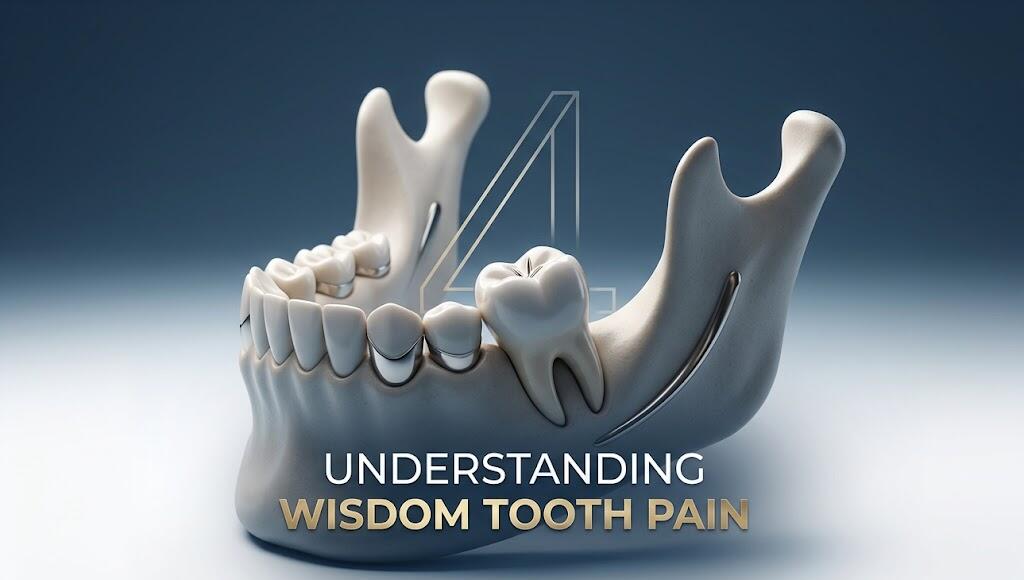
Impaction is the most common cause of wisdom tooth pain, and it occurs when a tooth cannot fully erupt through the gum line because it is physically blocked — either by another tooth, the angle of the jawbone, or simply a lack of available space.
Oral surgeons and dentists classify impactions into several types based on the tooth’s orientation on a panoramic X-ray:
- Vertical impaction: The tooth is growing in the correct direction but is blocked from breaking through the surface. It may be partially visible or completely buried.
- Mesial (angular) impaction: The most common type. The tooth tilts forward at an angle toward the second molar, pushing directly against it. This is a significant source of the “pressure” pain many patients describe.
- Horizontal impaction: The tooth lies completely on its side, oriented at 90 degrees. Instead of erupting upward, it drives laterally into the root of the adjacent molar. This type is frequently the most painful and the most likely to cause root damage to neighboring teeth.
- Distal impaction: The tooth tilts backward toward the rear of the jaw — less common, but still capable of creating significant bone pressure.
When a tooth is impacted, the pressure it exerts is relentless and cumulative. It doesn’t come and go the way a standard toothache might. Because the tooth is still biologically programmed to continue erupting, the force it applies to surrounding bone and adjacent teeth builds gradually — which is why impaction pain often intensifies over weeks and months rather than appearing suddenly.
The nerve-rich tissue surrounding the tooth becomes chronically inflamed, the periodontal ligament that anchors neighboring teeth experiences sustained mechanical stress, and in some cases the bone itself begins to remodel under the pressure.
What you feel: a deep, constant ache at the very back of the jaw, sometimes extending toward the ear or along the jawline. Biting down may intensify the pain because it increases the mechanical load on an already-stressed area.
2. Pericoronitis (The Flap Infection)
If your pain is accompanied by swollen, red gum tissue, an unpleasant taste in your mouth, or visible swelling in the cheek, pericoronitis is likely involved — and it deserves your immediate attention.
Pericoronitis is the inflammation and infection of the soft tissue surrounding a partially erupted wisdom tooth. When a wisdom tooth breaks through the gum surface only partially, it creates a natural flap of gum tissue — called an operculum — that partially covers the crown of the tooth. This flap is a bacterial trap.
Food debris, saliva, and bacteria collect beneath the operculum constantly. The pocket is virtually impossible to clean effectively with a toothbrush or floss. Even in patients with excellent oral hygiene, the anatomy of this space makes bacterial accumulation almost inevitable over time.
The bacteria that colonize this space are the same anaerobic bacteria responsible for other forms of periodontal infection — including species like Streptococcus and Prevotella intermedia — and they trigger a rapid, aggressive inflammatory response. The surrounding gum tissue swells, becomes tender to the touch, and in acute cases, produces localized pus.
What separates pericoronitis from standard gum sensitivity is the way the infection escalates:
- Acute pericoronitis develops quickly, typically within days, and is characterized by significant swelling, throbbing pain that wakes patients at night, and sometimes a fever.
- Chronic pericoronitis is more insidious — a persistent low-grade infection that causes recurring discomfort, bad breath, and occasional flare-ups. Many patients live with this for months before seeking treatment, which increases the risk of the infection spreading.
Left untreated, severe pericoronitis can progress to a deep space infection — a serious, potentially life-threatening condition discussed in the emergency warning section below.
3. Crowding and Structural Pressure
Even a wisdom tooth that erupts partially or at an angle — without becoming fully impacted — can cause significant pain through a purely mechanical process: it pushes.
When a horizontally or mesially tilted wisdom tooth presses against the root surface of the adjacent second molar, the force is direct and sustained. Think of it as a slow, constant wedge being driven between teeth that have been stable for years.
The consequences extend beyond localized discomfort:
Root resorption: The pressure from a poorly angled wisdom tooth can physically erode the root of the neighboring molar — a process called external root resorption. The second molar, which is one of your most functionally important teeth, can be structurally compromised without causing obvious symptoms until the damage is significant.
Dental crowding: In the anterior (front) region of the mouth, some patients notice their previously straight teeth beginning to crowd or overlap. While the direct causal relationship between wisdom teeth and incisor crowding is debated in orthodontic literature, there is clinical evidence that mesial pressure from erupting third molars contributes to shifting in some patients — particularly those with already-limited arch space.
Nerve pain: The inferior alveolar nerve runs through the lower jaw and supplies sensation to the lower teeth, gum, and lip. A lower wisdom tooth under significant eruptive pressure can impinge on this nerve pathway, producing radiating pain that travels along the jaw, into the ear, and sometimes up toward the temple — mimicking earache, sinus pain, or even headache.
📌 [Visual Directive: Insert a panoramic dental X-ray here showing an impacted lower wisdom tooth angled into the root of a second molar. This image is clinically powerful — it immediately validates the patient’s experience and illustrates why the pain radiates beyond the immediate site.]
This radiating quality of wisdom tooth pain is one of the reasons it is frequently misattributed to other conditions — earaches, sinus infections, migraines, or TMJ disorders — sometimes delaying an accurate diagnosis for months.
4. Cysts and Tumors (The Silent Threat)
This is the complication that makes routine wisdom tooth monitoring genuinely important, even for patients who aren’t currently in significant pain.
Every wisdom tooth develops inside a follicle — a small sac of fluid that surrounds the tooth during development. In normal circumstances, this follicle diminishes as the tooth erupts. When a wisdom tooth remains impacted and fails to erupt, that follicle can continue to enlarge, forming what is known as a dentigerous cyst.
Dentigerous cysts are among the most common cysts found in the oral cavity. They are generally benign but are insidious in their behavior: they expand slowly, under the surface of the gum and bone, without producing significant pain in their early stages. By the time they become symptomatic, they may have already:
- Eroded a significant portion of the surrounding jawbone
- Displaced or damaged the roots of adjacent healthy teeth
- Compressed or displaced the inferior alveolar nerve
- Created structural weakness in the mandible significant enough to increase fracture risk
In rare but documented cases, these cysts can undergo pathological transformation into more aggressive lesions, including ameloblastomas (locally invasive tumors originating from dental tissue) or, in extremely rare instances, malignant transformation.
This is precisely why oral surgeons and dentists recommend periodic panoramic X-rays to monitor asymptomatic impacted wisdom teeth — not because every impacted tooth requires extraction, but because silent progression is a genuine clinical risk that patients deserve to be informed about.
The critical takeaway: the absence of pain does not mean the absence of a problem.
Infected Wisdom Tooth Symptoms: What Does the Pain Feel Like?
Because wisdom tooth pain can radiate, mimic other conditions, and vary significantly in intensity and character, it helps to categorize your symptoms systematically. Use this reference checklist to assess where you are on the spectrum.
Localized Signs (Typically Earlier Stage)
These symptoms originate at or immediately adjacent to the affected tooth and represent the initial inflammatory response:
- Throbbing pain at the very back of the mouth — often worse at night when lying flat, as this increases blood pressure in the area
- Red, swollen, or tender gum tissue surrounding the eruption site
- Bleeding gums when brushing near the area, even with gentle pressure
- Persistent bad breath (halitosis) that doesn’t resolve with brushing — a direct sign of bacterial activity beneath the gum flap
- An unpleasant, bitter, or metallic taste that returns throughout the day, indicating active infection or pus drainage
- Difficulty fully opening the mouth due to swelling pressing on the muscles of mastication
- Food becoming trapped in the tissue behind the last visible molar
Systemic and Severe Signs (Requires Prompt Dental Attention)
These symptoms indicate that the infection or inflammatory process has moved beyond the immediate tooth site:
- Radiating earache — pain that feels like it’s originating inside the ear, caused by nerve pathway involvement
- Chronic or recurring headaches, particularly at the temple or across the jaw
- Jaw stiffness or locking (TMJ involvement) — difficulty opening the mouth more than a finger’s width
- Swollen lymph nodes beneath the jaw or in the upper neck, indicating the immune system is responding to a spreading infection
- Low-grade fever — a systemic fever accompanying dental pain is a serious warning sign, not a coincidence
- Facial asymmetry — visible swelling on one side of the face or cheek
A note on pain character: Wisdom tooth pain can present as throbbing, constant, sharp, pressure-like, or burning — often cycling between these qualities. Patients frequently describe it as a pain they “can feel in their jaw bone.” This bone-deep quality is characteristic of the periosteal (bone membrane) inflammation that occurs with impaction and infection.
Wisdom Teeth Coming in Pain Relief: Temporary Home Remedies
These measures are designed to manage discomfort while you arrange professional evaluation. They are not a substitute for diagnosis and treatment — wisdom tooth pain does not resolve permanently without addressing the underlying structural or infectious cause. But they are legitimate, evidence-supported methods for reducing your immediate suffering.
Warm salt water rinses — Dissolve half a teaspoon of table salt in a cup of warm water and rinse gently for 30 seconds, allowing the solution to reach the back of the mouth. Repeat 3 to 4 times daily, particularly after eating. Salt water is a gentle osmotic agent that reduces bacterial load, draws inflammatory fluid from swollen tissue, and cleanses the gum pocket around a partially erupted tooth. It will not eliminate an infection, but it genuinely reduces the bacterial environment that feeds pericoronitis.
NSAIDs (Ibuprofen) — Over-the-counter ibuprofen (400mg–600mg for adults, following package instructions) is more effective than acetaminophen for wisdom tooth pain specifically because it acts on both pain signaling and the prostaglandin-driven inflammatory cascade responsible for the swelling and pressure. Take it consistently at timed intervals rather than waiting until the pain becomes severe, as it works best when a steady anti-inflammatory level is maintained in the bloodstream. Always take with food.
Cold compress therapy — Apply a cold pack or a bag of ice wrapped in a thin cloth to the outside of the jaw for 15 to 20 minutes, then remove for an equal period. Cold therapy constricts blood vessels, reduces local inflammatory mediators, and creates a numbing effect on the surrounding nerve tissue. Apply on the outside of the cheek — applying cold directly inside the mouth against swollen gum tissue is not recommended.
Clove oil (eugenol) — A small amount of clove oil applied carefully to the gum tissue surrounding the painful tooth using a cotton swab provides temporary numbing relief. Eugenol is the same compound used in many professional dental preparations for its analgesic and mild antimicrobial properties. Use sparingly — direct contact with the tongue or soft palate causes intense burning.
Elevate your head while sleeping — Lying completely flat allows blood to pool in the head and increases inflammatory pressure at the site. Propping yourself up with an extra pillow reduces nocturnal throbbing, which is why wisdom tooth pain so consistently disrupts sleep.
When Is Wisdom Tooth Pain an Absolute Emergency?
⚠️ Seek Immediate Emergency Dental or Medical Care If You Experience Any of the Following:
- Difficulty swallowing or breathing
- Swelling that has visibly spread to your cheek, under the chin, the floor of your mouth, your neck, or the area beneath your eye
- Inability to open your mouth more than one finger’s width (trismus)
- A fever above 38.5°C (101.3°F) in conjunction with jaw pain and swelling
- Visible pus draining from the gum site combined with spreading facial swelling
These are not symptoms to “wait and see” on. They indicate a potentially life-threatening deep space infection — specifically Ludwig’s angina or a spreading fascial space abscess — in which bacteria from a dental infection have broken through local tissue boundaries and are tracking through the connective tissue planes of the neck and floor of the mouth.
Deep space dental infections can compromise the airway with alarming speed. They represent true medical emergencies requiring hospitalization, intravenous antibiotics, and in many cases surgical drainage. Patients and family members should not drive to a GP or wait for a next-day dental appointment — an emergency room is the appropriate destination.
The pathway from a neglected pericoronitis to a serious deep space infection is not theoretical. It is a documented clinical progression that occurs every year in otherwise healthy young adults. The age group most affected — 17 to 25 — is precisely the demographic most likely to delay dental care.
How Dentists Fix Wisdom Tooth Pain Permanently
Understanding the clinical process often makes it significantly less intimidating. Here is what to expect when you seek professional care.
Step 1: Diagnostic Imaging The cornerstone of wisdom tooth assessment is a panoramic X-ray (OPG — orthopantomogram). This full-arch image gives your dentist or oral surgeon a complete picture of all four wisdom teeth simultaneously: their exact position, angle, depth, the proximity to the inferior alveolar nerve, the presence of cysts, and the degree of impact on adjacent teeth. Some practices supplement this with a CBCT scan (cone beam computed tomography) for three-dimensional nerve mapping before complex extractions.
Step 2: Clinical Assessment Your clinician will probe the gum tissue around the affected tooth, assess the depth of any periodontal pocket, check for limited mouth opening, and palpate the lymph nodes beneath your jaw. If acute infection is present, antibiotics may be prescribed before extraction to reduce the risk of post-operative complications.
Step 3: The Decision — Extract or Monitor? Not every impacted wisdom tooth requires immediate extraction. Clinical decision-making considers:
- The degree of impaction and angle
- Whether symptoms are acute or chronic
- Proximity to the inferior alveolar nerve (particularly for lower third molars)
- Patient age (root formation is typically less complete in younger patients, making extractions technically easier)
- Evidence of pathological changes (cysts, root resorption)
Asymptomatic, fully bony-impacted wisdom teeth that show no signs of pathological change may be monitored periodically rather than extracted immediately — particularly if the nerve proximity makes surgery high-risk.
Step 4: Extraction For most straightforward extractions, a general dentist working under local anesthesia can complete the procedure in 20 to 40 minutes. For complex impactions — particularly deeply embedded lower wisdom teeth close to the inferior alveolar nerve — referral to an oral and maxillofacial surgeon is standard practice. Sedation options (IV sedation or general anesthesia) are available and widely used, particularly for patients having multiple teeth removed simultaneously.
The post-operative recovery for most patients runs 3 to 5 days of meaningful discomfort managed with NSAIDs and prescribed pain medication, with full healing of the socket over 4 to 6 weeks. Dry socket (alveolar osteitis — where the protective blood clot fails to form or is dislodged) is the most common post-operative complication, occurring in roughly 3–4% of routine extractions and up to 30% of lower impacted extractions; it is entirely manageable when caught early.
Don’t Ignore the Ache
Wisdom tooth pain has a quality that tempts people to wait it out — it flares, it subsides, it becomes almost manageable for a few days, and then it returns. That cycle of temporary relief is one of the most important things to understand about this condition: it is not resolution. It is the biological reality of an infection being partially suppressed by your immune system before reasserting itself, or a period of reduced mechanical pressure before the tooth continues its relentless eruptive force.
Wisdom tooth pain rarely self-resolves permanently. The structural causes — impaction, crowding, a partially erupted tooth creating a chronic bacterial pocket — do not change without clinical intervention. What changes, if left untreated, is that they worsen.
The good news is that once the underlying cause is addressed, the relief is typically complete and permanent. Extraction of a problematic wisdom tooth ends the pain cycle definitively.
If your wisdom tooth pain has persisted for more than 48 hours, has been recurring over weeks, or is accompanied by any of the systemic symptoms listed above, this is your clear signal to act.
📅 next step: Schedule a consultation and panoramic X-ray assessment with your dentist or oral surgeon. A single diagnostic appointment will give you a complete clinical picture of what’s happening beneath the surface — and a clear, evidence-based plan for resolving it permanently.