Why Do Kids Get Cavities Between Teeth — Even When They Brush Properly?
If your child brushes twice a day and still comes back from a dental checkup with a cavity, you’re not doing anything wrong. You’re running into a gap in oral anatomy that no toothbrush, however well used, can close on its own.
At Smile Craft, this is one of the most common situations parents bring to me, usually with the same confused first question: “But we brush every day — how did this happen?”
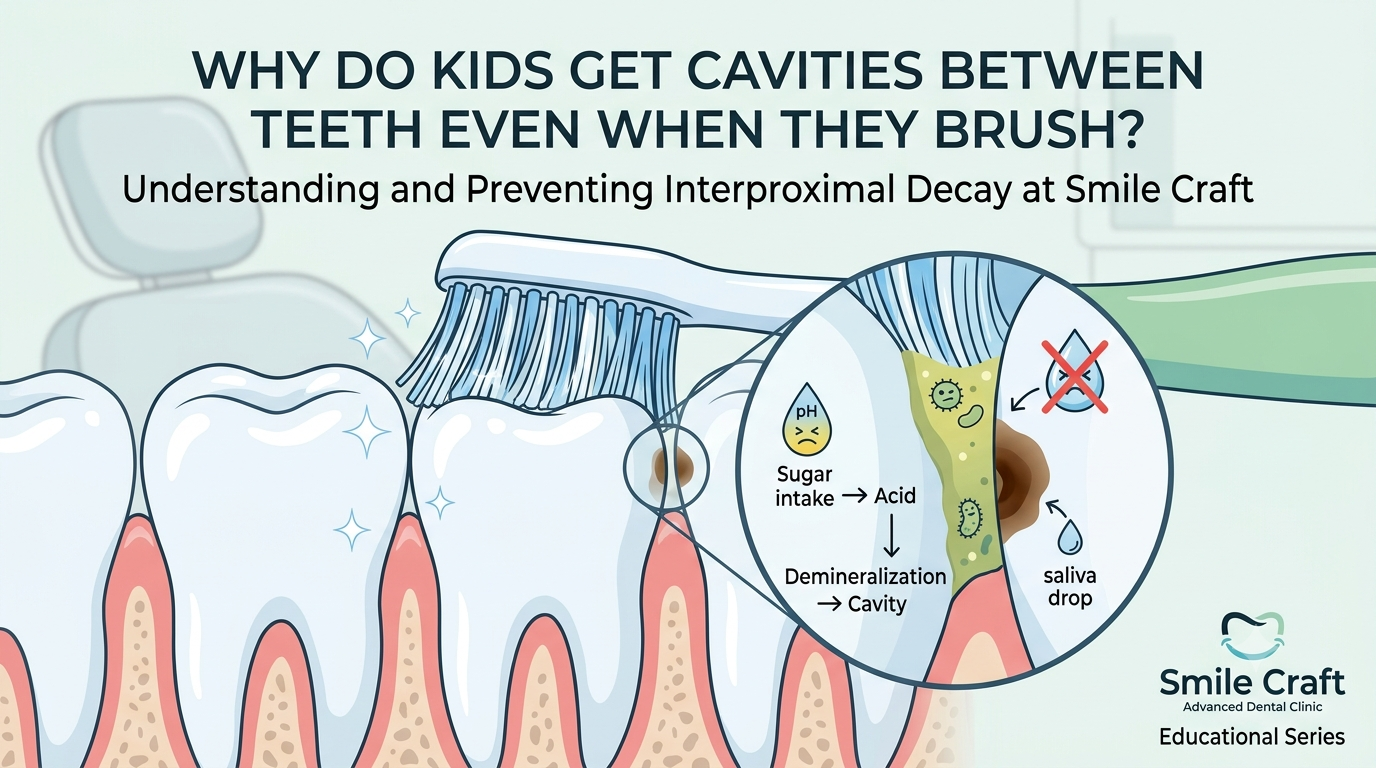
The short answer is that most cavities in children aren’t forming on the surfaces a toothbrush cleans. They’re forming in the contact point between two teeth, a space a bristle physically cannot enter. Here’s exactly why that happens, and what actually stops it.
The Toothbrush Can Only Clean What It Can Touch
A toothbrush cleans by mechanical contact — bristles physically scraping plaque off a surface. This works well on the outer (cheek-facing) and inner (tongue-facing) surfaces of teeth, and reasonably well on the chewing surface.
It does not work on the interproximal surface — the side of the tooth pressed against its neighbor. There’s no gap for a bristle to enter. In baby teeth especially, the contact between adjacent teeth is often broad and tight, which is good for chewing function but leaves almost no natural clearance for cleaning.
So plaque left undisturbed at that contact point isn’t being neglected by your child — it’s structurally unreachable by brushing alone. Left there, it matures.
What “Plaque Maturing” Actually Means
Plaque isn’t just leftover food. It’s a live bacterial colony, and the longer it sits undisturbed, the more organized and acid-productive it becomes.
Here’s the mechanism, step by step:
- Bacteria feed on sugars and starches left on the tooth surface after eating, producing acid as a byproduct.
- That acid drops the pH at the tooth surface, pulling minerals (calcium, phosphate) out of the enamel — this is called demineralization.
- Saliva normally reverses this by washing the acid away and redepositing minerals back into the enamel (remineralization). This is a genuine tug-of-war that happens dozens of times a day in every mouth.
- At the interproximal surface, saliva has far less access. The two teeth are pressed together, so saliva can’t flow through and rinse the acid out the way it can on an exposed surface.
- Without disruption, the bacterial colony matures into a stable biofilm within roughly 24 to 48 hours — at which point it’s far more resistant to being removed by anything except direct mechanical interruption (flossing) or a fluoride-driven remineralization boost.
This is why frequency of sugar exposure matters more than total quantity. A child who eats one dessert after dinner gives their enamel one acid attack and hours to recover before the next meal. A child who sips a sweet drink throughout the afternoon or grazes on crackers between meals keeps the mouth in a near-constant low-pH state, with no recovery window — even if the total sugar consumed is lower.
Combine that with a surface saliva barely reaches, and the interproximal contact point becomes the single most cavity-prone spot in a child’s mouth — which matches what shows up in dental research: the majority of decay in children between roughly ages 5 and 10 is found on interproximal surfaces, not the chewing surfaces parents tend to focus on.
Why This Catches Parents Off Guard
Three things make interproximal cavities specifically easy to miss at home:
- No visible sign for a long time. Early demineralization shows up as a faint white or chalky spot, and it’s on a surface you can’t see without a mirror or dental instrument to separate the teeth.
- No pain until it’s advanced. Pain generally starts once decay reaches the dentin layer beneath the enamel — by which point the cavity has already been progressing for a while.
- “They brush well” gives false reassurance. Good brushing habits are genuinely protective for most tooth surfaces, which can make a cavity feel like a contradiction rather than an expected outcome of an unreached surface.
This is also exactly why we use bite-wing X-rays at routine checkups rather than relying on visual exam alone — they’re the only reliable way to catch an interproximal cavity while it’s still small enough to treat conservatively.
Check your child’s cavity risk
Answer a few quick questions to see where to focus first.
Age-by-Age: What Actually Prevents This
Cavity risk and what’s practical to expect from a child both shift by age, so a single generic checklist undersells what’s actually needed at each stage.
Ages 0–2 (before and around first teeth)
- Wipe gums with a clean, damp cloth before teeth even erupt — this establishes the habit and reduces early bacterial colonization.
- Once teeth appear, brush with a rice-grain smear of fluoride toothpaste, twice daily.
- Avoid putting a child to bed with a bottle of milk, formula, or juice — prolonged contact overnight, combined with reduced saliva flow during sleep, is one of the most concentrated risk patterns at this age (sometimes called early childhood caries).
- First dental visit by age one, or within six months of the first tooth appearing — this is earlier than most parents expect, and it’s the right time to start.
Ages 3–5
- Parent-led brushing continues; most children lack the fine motor control to brush effectively on their own until around age 6–7.
- Begin flossing as soon as any two teeth touch each other — this is often earlier than parents assume, sometimes as early as age 2–3.
- Ask about dental sealants once first molars erupt. Sealants address the chewing-surface risk; they don’t address interproximal risk, so they complement flossing rather than replace it.
- Limit grazing on crackers, dried fruit, and juice between meals — frequency, not just quantity, is the lever that matters here.
Ages 6–9
- Mixed dentition (both baby and permanent teeth present) means more contact points to manage at once — this is often when interproximal cavities first appear if flossing hasn’t been established.
- Supervise brushing even after a child starts doing it independently; most children still miss the same few spots consistently.
- Fluoride varnish applications at routine visits add a protective layer specifically at contact points where brushing can’t reach.
Ages 10–12
- Permanent molars are fully in and the child likely has more independence in their routine — worth actively checking in on flossing consistency rather than assuming it’s happening.
- Orthodontic appliances, if present, create additional plaque traps and usually need a specific cleaning routine — ask your dentist for guidance if braces are in the picture.
Use the Tool Below to Check Where Your Child Stands
Every child’s risk profile is a little different depending on age, current habits, and diet pattern. The checklist below walks through the specific risk factors for interproximal cavities at your child’s age and gives a plain-language read on where to focus first.
[Interactive age-based cavity risk checklist embeds here]
Frequently Asked Questions
My child flosses sometimes but not every day. Does that still help? Partially, but the protective effect comes from disrupting the bacterial colony before it matures into a stable biofilm — a process that takes roughly 24–48 hours. Flossing every other day leaves gaps long enough for that maturation to complete repeatedly. Daily flossing is what actually interrupts the cycle.
Can a cavity between teeth heal on its own? In its earliest stage — before the enamel surface has broken down, sometimes visible as a white spot — remineralization is possible with fluoride exposure and improved hygiene. Once the surface has cavitated (an actual hole has formed), it cannot heal on its own and needs restorative treatment.
Are baby teeth with cavities worth treating if they’ll fall out anyway? Yes. Untreated decay in baby teeth can lead to infection, pain, and can affect the developing permanent tooth underneath. Baby teeth also hold space for permanent teeth to erupt correctly — losing one early to decay can cause alignment problems later.
Is flossing really necessary if my child uses a water flosser? Water flossers can help but are generally less effective than string floss at fully disrupting plaque at a tight contact point, particularly in baby teeth. They’re a reasonable addition, not usually a full replacement, especially before permanent teeth create slightly more natural spacing.
This article was reviewed by Dr. Kusum at Smile Craft. It’s intended for general educational purposes and isn’t a substitute for an in-person dental evaluation — if you’re concerned about a specific cavity or symptom, book a visit so we can take a proper look.